Industry News
News Center
2025.12.15
Robotic Arms: Reshaping Production Models Across Industries, Ushering in a New Era of Automation.
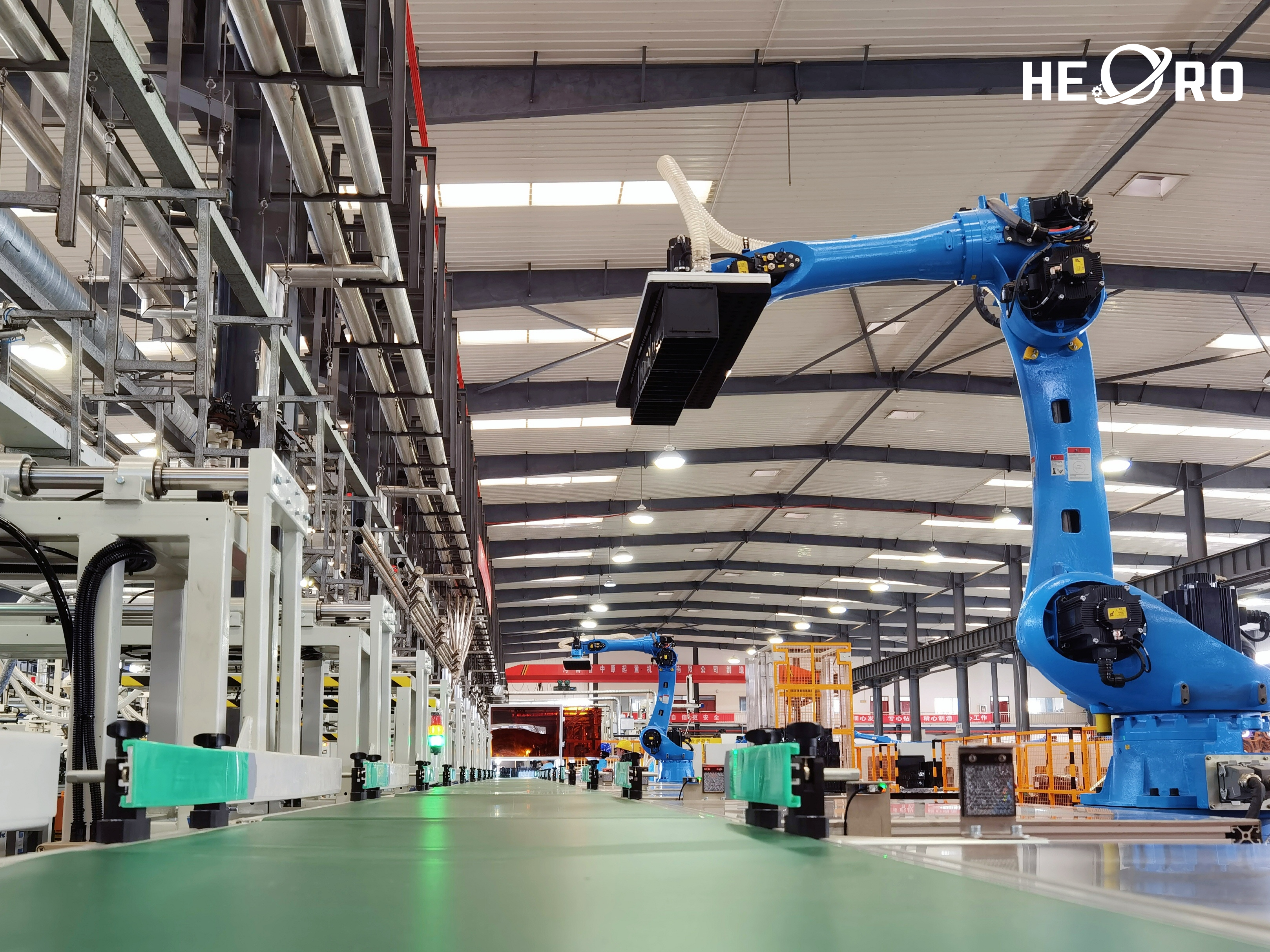
As the manufacturing sector accelerates its transformation and upgrading, bottlenecks in manual operations within traditional production models have become increasingly apparent. Challenges like labor shortages and insufficient precision have emerged as significant constraints on business development. Against this backdrop, robotic arms, with their unique advantages, are gradually transitioning from high-end manufacturing to mainstream production scenarios, becoming a vital force driving industrial transformation. Whether handling high-precision component machining or high-intensity material handling, robotic arms can meet diverse industry production demands through their flexible operational capabilities.
In the automotive manufacturing sector, robotic arms have long been the “main force” on production lines, with their applications spanning multiple critical stages of vehicle assembly. In body welding operations, traditional manual welding not only involves high labor intensity but also suffers from unstable precision and inconsistent quality. Robotic arms, however, can execute each welding point with millimeter-level accuracy according to pre-programmed sequences. They also enable 24/7 uninterrupted operation, significantly boosting both efficiency and quality in body welding. In component assembly, robotic arms demonstrate remarkable adaptability. Whether performing intricate engine assembly or installing doors and seats, they execute tasks swiftly and accurately, effectively reducing human error rates and shortening overall vehicle production cycles.
The electronics manufacturing industry demands exceptionally high operational precision, making robotic arms indispensable. In the processing of components for electronic products like mobile phones and computers—including chip packaging, circuit board soldering, and display assembly—traditional manual operations struggle to meet micron-level precision requirements. Robotic arms, equipped with high-precision sensors and flexible mechanisms, can execute every minute operation with accuracy. During product inspection, robotic arms integrate with testing equipment to automate quality checks, swiftly identifying non-conforming items and enhancing both efficiency and accuracy. Moreover, robotic arms adapt to the electronics industry's rapid product turnover. Through simple program adjustments, they swiftly adapt to new production tasks.
The rapid growth of logistics and warehousing has also driven widespread robotic adoption. In parcel sorting, goods handling, and warehouse management, robotic arms effectively address issues like high labor intensity, low sorting efficiency, and high error rates. In parcel sorting centers, robotic arms utilize image recognition technology to swiftly identify package information and accurately route parcels to designated zones with minimal sorting errors. Within warehouse management, robotic arms integrate with automated storage systems to perform tasks like goods intake, storage, retrieval, transportation, and stacking. This not only optimizes storage space utilization but also significantly boosts overall warehouse operational efficiency.
Beyond these sectors, robotic arms find extensive applications in food processing and new energy industries. In food processing, they handle tasks like grabbing, packaging, and sorting goods, eliminating hygiene risks from manual contact while boosting production efficiency. In new energy, robotic arms play crucial roles in lithium battery manufacturing and solar panel assembly, driving the large-scale development of the new energy sector.