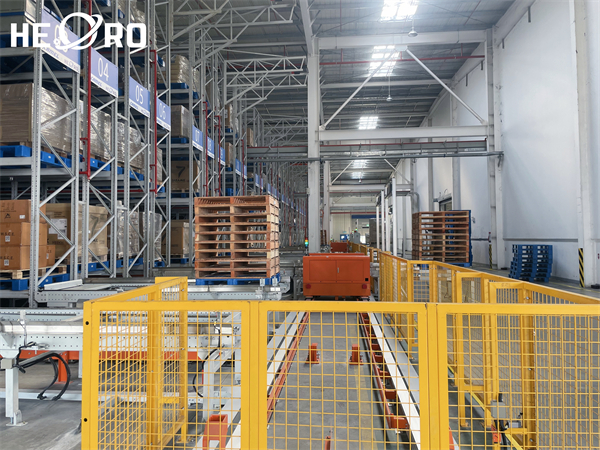
As manufacturing transitions toward intelligent and unmanned operations, the limitations of traditional material handling methods—including inefficiency, high error rates, and labor-intensive processes—are becoming increasingly apparent. RGV rail-guided vehicles, with their unique technological advantages, are increasingly becoming a vital solution for enterprises to replace manual handling and optimize production processes. Designed to operate along tracks, RGVs can execute automated start/stop functions, precise positioning, and path planning through pre-set programs or control systems. This not only significantly boosts transfer efficiency but also effectively reduces human-induced errors, providing robust assurance for building efficient and stable production logistics chains.
In large e-commerce warehouses and intelligent sorting facilities, RGVs integrate with automated storage and retrieval systems (AS/RS) to automate material inbound and outbound operations. Upon receiving system commands, RGVs swiftly respond by navigating along pre-set tracks to designated storage locations, executing a series of operations including material pickup, transportation, and placement. Compared to traditional manual handling and forklift transfers, RGVs not only enhance transfer efficiency but also enable 24/7 uninterrupted operation, significantly improving warehouse space utilization and material turnover rates.
The automotive manufacturing industry represents a key application scenario for RGVs. On vehicle assembly lines, RGVs handle component transportation and workstation handover tasks. They reliably manage everything from moving large parts like engines and transmissions to delivering smaller components such as doors and seats. Given the automotive industry's stringent demands for precision and efficiency, RGVs ensure components are transported without collisions or damage through millimeter-level positioning accuracy. They also strictly adhere to production cadences for material delivery, effectively preventing production line stoppages. Furthermore, RGVs can collaborate with robots, conveyor belts, and other automated equipment to build fully automated production systems, further advancing the intelligence of automotive manufacturing.
In the electronics processing industry, RGV rail-guided vehicles also play a vital role. Electronic components are characterized by their small size, high precision, and fragility, demanding exceptional stability and safety during transportation. RGV vehicles feature flexible designs that allow customized transportation solutions tailored to component characteristics. Equipped with anti-slip and anti-vibration protection devices, they ensure components remain undamaged throughout transit. In electronic chip production workshops, RGVs transport raw materials from warehouses to production equipment, then move finished products from production equipment to testing stations and finished goods warehouses, achieving fully automated transportation throughout the entire production process. By implementing RGVs, electronics companies not only enhance transportation efficiency and product yield rates but also reduce contamination risks during production, providing robust support for achieving high-quality manufacturing.