Amid the deepening development of smart manufacturing and intelligent logistics, automated high-bay warehouses—as a core upgrade solution in the warehousing sector—are gradually replacing traditional flat warehouses, becoming a key driver for enterprises to reduce costs, improve efficiency, and enhance core competitiveness. With land resources growing increasingly scarce and labor costs continuing to rise, automated high-bay warehouses, leveraging advantages such as high space utilization, rapid operational efficiency, and refined management, have been widely adopted across multiple industries including chemicals, e-commerce, automotive, and new energy, driving the digital transformation of the warehousing and logistics industry.
Centered around high-rise racking systems, automated vertical warehouses integrate automated equipment such as stacker cranes and four-way shuttle robots with WMS (Warehouse Management System) and WCS (Warehouse Control System) to achieve full automation across the entire process of goods storage, retrieval, handling, and inventory counting. This significantly reduces manual intervention, thereby lowering labor costs and minimizing human error. Compared to traditional warehouses, automated high-bay warehouses can increase vertical space utilization to over 90% and boost storage capacity per unit area by 40%–60%, effectively alleviating the challenge of limited warehouse space for enterprises.
In recent years, policies have continued to support the development of the smart manufacturing industry. Policies such as the “Guiding Opinions on Promoting High-Quality Development of the Petrochemical Industry during the 14th Five-Year Plan Period” explicitly call for accelerating the industry’s digital transformation, providing a favorable policy environment for the widespread adoption of automated vertical warehouses. Currently, the domestic market for automated vertical warehouses continues to grow, with the installed base steadily increasing. More and more enterprises are beginning to plan for the construction of automated vertical warehouses to achieve lean and intelligent upgrades in warehouse management.
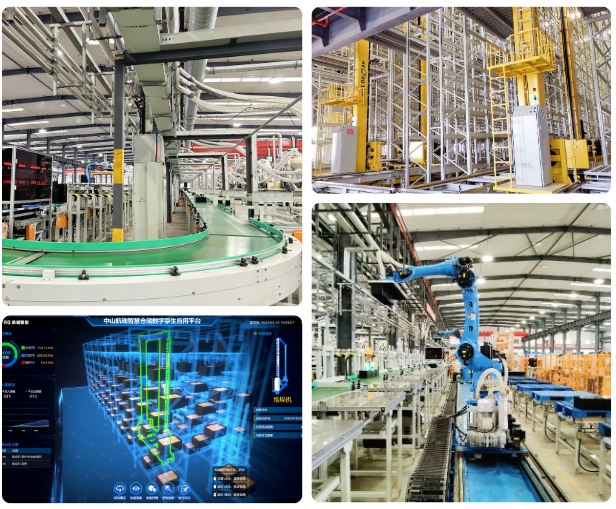
A well-designed automated high-rack warehouse solution can tailor warehouse layout planning and optimize operational workflows based on a company’s industry characteristics and specific needs. It enables seamless integration between WMS, MES, and ERP systems to create an end-to-end visual management system. For example, after a chemical company implemented an automated high-rack warehouse, its inbound and outbound handling efficiency increased to 160 pallets per hour, significantly reducing manual labor intensity. Simultaneously, the system enabled zoned, closed-loop management of raw materials, auxiliary materials, and finished goods, ensuring storage safety.
In the future, with the integration of technologies such as AI scheduling algorithms and digital twins, automated high-bay warehouses will evolve toward greater flexibility, intelligence, and sustainability, further adapting to the diverse warehousing needs of multiple industries. By adopting automated high-bay warehouses, enterprises can not only enhance warehouse operational efficiency but also eliminate bottlenecks in the logistics chain, injecting strong momentum into their own high-quality development and propelling the smart logistics industry to new heights.