Industry News
News Center
2026.09.17
Digital twins empower intelligent warehousing, driving warehouse management toward digitization
With the continuous advancement of technologies such as the Internet of Things, artificial intelligence, and automation, intelligent warehousing is rapidly evolving from traditional automated operations toward digital and intelligent management. In the face of challenges like increasing equipment numbers and complex business processes, real-time monitoring of warehouse operations and enhancing equipment coordination efficiency have become critical issues in corporate smart logistics development. The application of digital twin technology offers new solutions for intelligent warehousing management.
By connecting with systems such as WMS, WCS, MES, and ERP, the digital twin platform can centrally display key data including equipment operation, task execution, inventory status, and logistics processes, enabling managers to intuitively grasp the overall warehouse operation through a visual interface. In case of equipment anomalies or logistics congestion, it can also quickly locate issues, providing data support for fault handling and operational optimization.
Meanwhile, digital twins can also integrate historical operational data to analyze warehousing processes, equipment utilization, and logistics routes. By conducting virtual simulations in advance, they verify warehousing solutions and provide references for optimizing warehouse layouts, equipment scheduling, and operational workflows.
In the future, with the deep integration of digital twins with technologies such as AI and big data, their applications will evolve from "visual monitoring" to intelligent analysis, prediction, and decision-making. This advancement will drive the transformation of smart warehousing from "automatic execution" to "real-time sensing, intelligent collaboration, and intelligent decision-making," enabling enterprises to establish a more efficient, transparent, and flexible modern logistics system.
Digital twins create digital models of real-world warehousing scenarios, mapping automated equipment such as automated storage and retrieval systems (AS/RS), stackers, conveyors, AGVs, and shuttle vehicles, along with business data like inventory, orders, and tasks, into a digital space. This enables real-time synchronization between physical warehouses and virtual models.
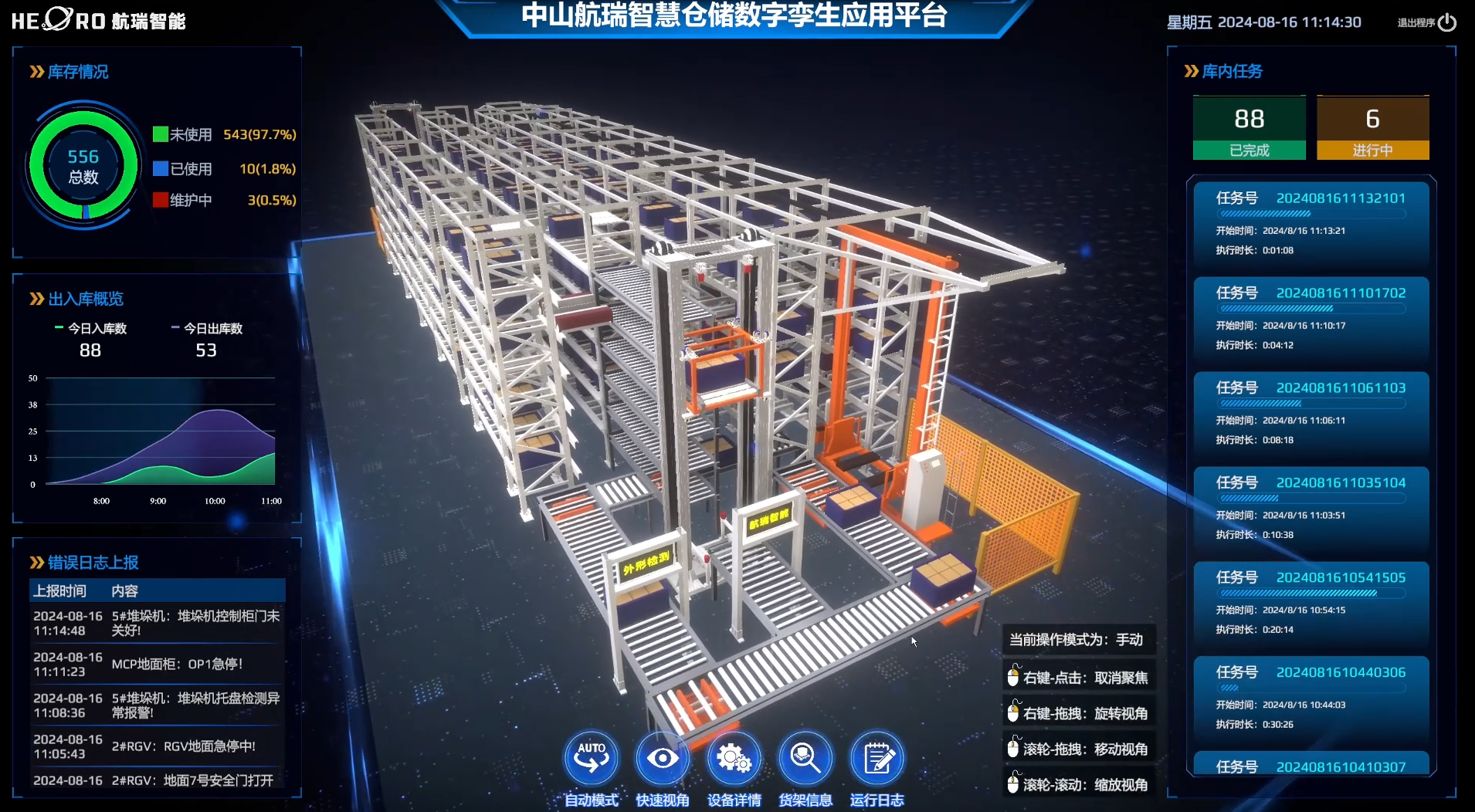
By connecting with systems such as WMS, WCS, MES, and ERP, the digital twin platform can centrally display key data including equipment operation, task execution, inventory status, and logistics processes, enabling managers to intuitively grasp the overall warehouse operation through a visual interface. In case of equipment anomalies or logistics congestion, it can also quickly locate issues, providing data support for fault handling and operational optimization.
Meanwhile, digital twins can also integrate historical operational data to analyze warehousing processes, equipment utilization, and logistics routes. By conducting virtual simulations in advance, they verify warehousing solutions and provide references for optimizing warehouse layouts, equipment scheduling, and operational workflows.
In the future, with the deep integration of digital twins with technologies such as AI and big data, their applications will evolve from "visual monitoring" to intelligent analysis, prediction, and decision-making. This advancement will drive the transformation of smart warehousing from "automatic execution" to "real-time sensing, intelligent collaboration, and intelligent decision-making," enabling enterprises to establish a more efficient, transparent, and flexible modern logistics system.