As the digital transformation of the manufacturing sector continues to deepen, “smart factories” are moving from concept to large-scale implementation. In this process, intelligent automated warehouses—as a vital component of modern smart factories—are becoming a key tool for enterprises to improve warehousing efficiency and reduce operational costs.
Leveraging automated multi-level racking, stacker cranes, conveyor systems, and WMS (Warehouse Management Systems), intelligent automated warehouses enable automated storage and retrieval of goods along with precise inventory management. Compared to traditional flat warehouses, intelligent automated warehouses can save over 60% of floor space, increase storage capacity by 3 to 5 times, and significantly reduce reliance on manual labor and error rates. For manufacturing enterprises facing high land costs and frequent order fluctuations, this is undoubtedly an optimal path to enhancing supply chain resilience.
Within the overall architecture of a smart factory, the intelligent automated warehouse serves not only as a centralized material storage hub but also as a “regulator” of production rhythms. By integrating data with MES (Manufacturing Execution System) and ERP systems, the intelligent automated warehouse can respond in real time to production plans, enabling the seamless flow of raw materials, semi-finished goods, and finished products. For example, in a smart factory project for automotive components, the introduction of an intelligent automated warehouse increased material delivery on-time performance to 99.2%, reduced production line downtime by 40%, and significantly boosted overall production efficiency.
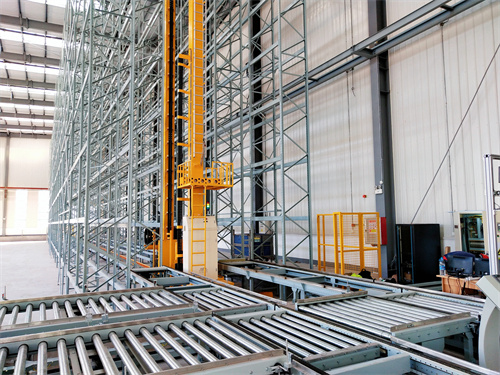
Currently, the technological evolution of intelligent automated warehouses is moving toward greater flexibility and enhanced intelligence. The integrated application of cutting-edge technologies such as AI vision recognition, digital twin simulation, and 5G edge computing has equipped intelligent automated warehouses with capabilities including dynamic path planning, predictive equipment maintenance, and intelligent inventory optimization, further unlocking the potential of smart manufacturing.
At the market level, industry data indicates that by 2025, the scale of China’s intelligent automated warehouse market will exceed 100 billion yuan, with widespread application in high-growth sectors such as automotive, electronics, pharmaceuticals, and cold chain logistics. On the policy front, the “14th Five-Year Plan for the Development of Intelligent Manufacturing” explicitly calls for the promotion and application of intelligent logistics equipment, providing strong support for the widespread adoption of intelligent automated storage and retrieval systems.
For enterprises, deploying intelligent automated storage and retrieval systems represents not only an upgrade to the warehousing process but also a crucial step toward building smart factories. In the future, as the Industrial Internet matures, these systems will become deeply integrated into the entire value chain, serving as core infrastructure to drive high-quality development in the manufacturing sector.